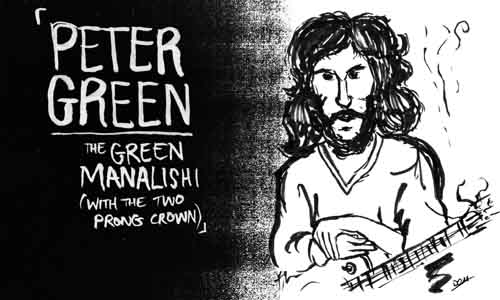
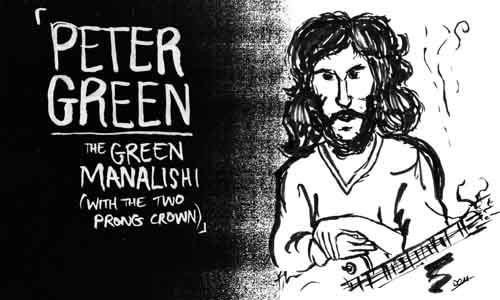
DOM COOPER explorea Fleetwood Mac’s dark and beastly The Green Manalishi (with The Two Prong Crown) with Peter Green.
(The night is so black the darkness cooks )
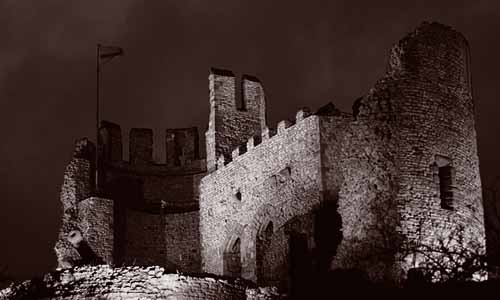
Picture a large gothic mansion in a black forest near Munich. A taxi draws up and two men get out. They cut across the beams of the headlights and go inside the house.
On entering, they walk into a sixties party in full swing. All psychedelic lights, loud music and writhing flesh. Just like the club scene from Roger Corman’s film ‘The Trip’.
The two men squirm through the crowd, past naked bodies, and ignore alien German questions aimed at them. The smaller of the two leads his tall-gangly companion down into the basement. They seem anxious and uneasy – probably because the LSD they had taken earlier is now turning bad on them.
Nearing the steps they can feel loud dark vibrations from below. On descending, their senses start to play tricks, and they see a gathering of people whose faces distort and melt.
Emanating from the center of the room is music that grows ever darker. At the room’s heart they find the bearded brother they have come to rescue. Sweat dripping, eyes closed, he rings long notes from the neck of his guitar.
The music booms out all around him. It feels claustrophobic and evil to the pair, and they want to get out as soon as possible. They try to stop their guitarist from playing, but strangers intervene.
He is lost within the music, and seems unaware of their presence. A beautiful girl holds court and waves them away. Eventually they manage to wrangle the guitarist from the strangers and back up to the waiting taxi. Slumping down into their seats they sigh relief and try to relax. In between them their friend cradles his telecaster and stares out vacantly.
Meet Peter Green, Fleetwood Mac
Meet Peter Green. Guitarist with the band Fleetwood Mac. He was born in 1946, in London’s Bethnal Green.
London in the 1960s witnessed a succession of bands that drew upon the blues. Young men were transfixed by the music – and they sought precious imported 7″s from the U.S.
Glistening tomes of wax from artists such as Howling Wolf and Son House. Every week a new band sprang up- their guitarists becoming gods. Rapidly Peter Green emerged to take the crown.
After a brief stint in John Mayall’s Bluebreakers, Green helped form Fleetwood Mac with drummer Mick Fleetwood (who was fired by Mayall for drunkenness).
The band entered the circuit and gained a good reputation as a live band. Later upon signing with the Blue Horizon label they recorded an album, but had it yielded no hits.
Another two albums appeared and they built steadily. The pace all changed though when Peter wrote an instrumental called ‘Albatross’. Released as a single, the song climbed to number one, propelling the band into the limelight.
Fast forward to the party in 1970. It was to be the bands last European tour with Peter; as he’d announced previously that he wanted to quit.
That night he had taken an enormous dose of LSD, and been enticed to the party by Highfisch (stoned fish) commune leaders Rainer Langhans and Uschi Obermaier.
Later they said they had invited him with the intention of getting his assistance in organising a free festival in Bavaria. They’d hoped that he’d be a link to inviting Jimi Hendrix and The Rolling Stones.
Returning from the party early, one of the band’s roadies informed them that Peter refused to leave. After a quick discussion Mick decided to accompany him back to the commune to rescue Peter. He remembers arriving to a debauched scene with a horrendous demonic dark music that drifted up from the basement.
Down below Peter jammed with the commune members as a tape machine rolled away in the background. Mick felt he had to get Peter out fast, and eventually did. Green later said of the event, ‘That’s the most spiritual music I’ve ever recorded in my life’.
Maybe due to that night, or due to his drug use before the tour (which had picked up pace during the recording of their third album ‘Then Play On’) Green started his decline. Accounts seem to be conflicting in a ‘can’t quite remember the sixties way’.
Whenever it was, Peter changed. He grew a beard, wore monks robes and protected himself with a large crucifix that hung from his neck; a totem to ward off the evil spirits.
Mick Fleetwood remembers that Peter became concerned about his wealth. He felt burdened by it and saw it as the devil’s temptation. He was anxious about world poverty, and wanted to give everything he made away, even trying to persuade the other band members to do the same.
Upon seeing a TV clip of starvation in Biafra, he couldn’t understand why they only had ‘white powder’ to eat. He felt they should be able to get aid together to send over, thinking he could fly sandwiches to eat instead.
After the European tour and the Munich ‘incident’ Peter made plans to leave the group. First he finished a few contractual commitments. His final swansong became the track ‘The Green Manalishi’. An insight into possession, his fear and demons.
What is the Green Manalishi?
The proto-metal track (it was covered by Judas Priest), is a hard blues. Hauntingly urgent and powerful. The Green Manalish (With The Two Prong Crown) is about Peter’s one obsession, money and how it represented the devil. It is said to be named after a type of LSD, which Peter denies. He says he wrote the song after having a drug-induced dream.
During which he saw a monstrous green dog that he felt represented money. He knew the dog was dead and had been for some time.
Peter also sensed he was dead too and struggled to return to his body. Upon waking to a black room he immediately picked up his guitar and the tune tumbled from him.
The following day he wrote the lyrics for the Green Manalishi whilst sat in Richmond Park – it’s calmer surroundings not brightening the dark subject matter at all.
On the recording the guitars are heavy and ominous. The rhythm is driving, echoing the theme of being chased. The vocals are confessional – a full moon brings things that creep and sneak around trying to drive the singer mad.
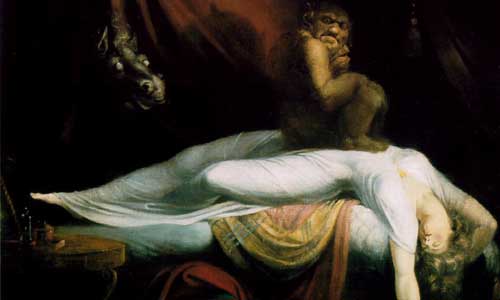
The night is so black that the darkness cooks. From the black, a dog is on the prowl – a Green Manalishi with a two pronged crown. A demonic horned beast that preys on the singers mind, breaking into his dreams. Towards the end wordless oo’s seem to taunt, as if representing the voices in his head.
Played live the song grew into an even darker beast, bristling with barbs.
As planned, Peter left Fleetwood Mac. He subsequently went on to record a solo album of long improvised jams called ‘The End Of The Game’.
It’s music far removed from his earlier blues output, but maybe closer to the commune jam (only those few who have heard it would know).
Although he finished the album, it seemed to be the end of the road for him musically, as he never recovered from his drug experiences.
Later he would re-emerge with a second career, but back then he was diagnosed with schizophrenia and put under psychiatric care, where he continued to battle his demons.